Comparison guide
LPE1 management pack vs a property report
Last updated:
Type the full address with its postcode to go straight to your report options. Try .
- 65+ official sources
- Emailed within 24 hours, usually faster
- Sources and coverage gaps named
- One-off payment, no subscription
What the report looks like inside
See the full sample →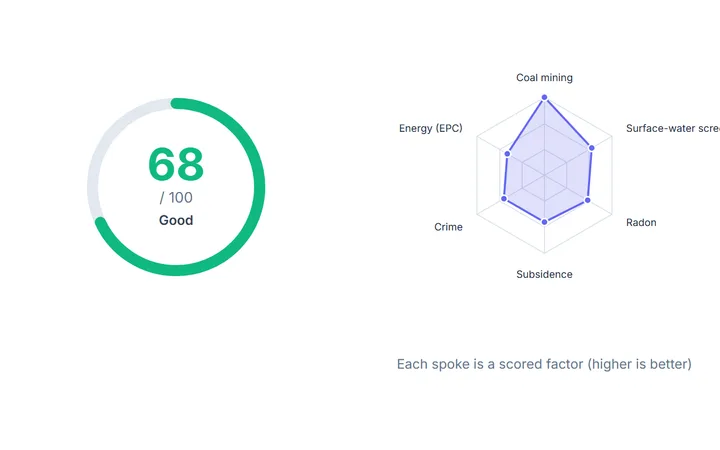 IQ Score and the factors behind it
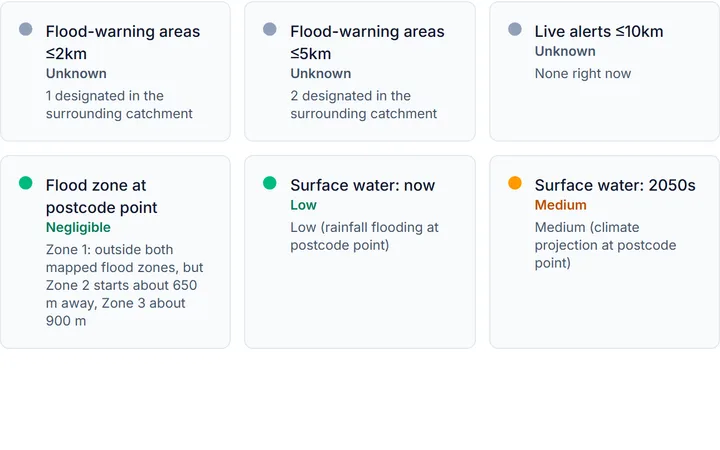 Flood risk at the postcode point
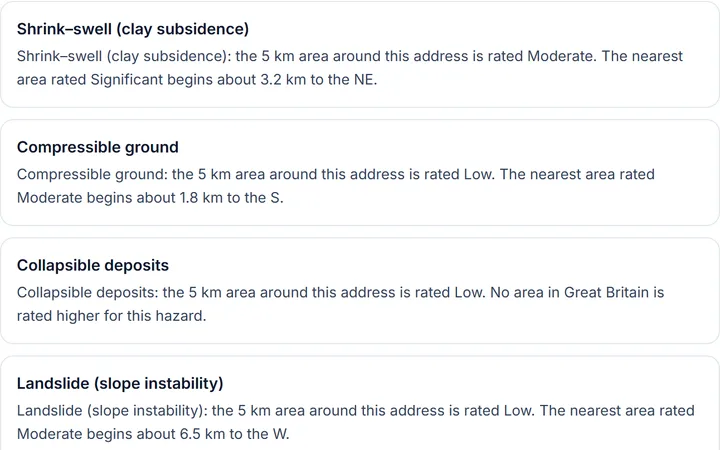 Six ground hazards, rated for the area
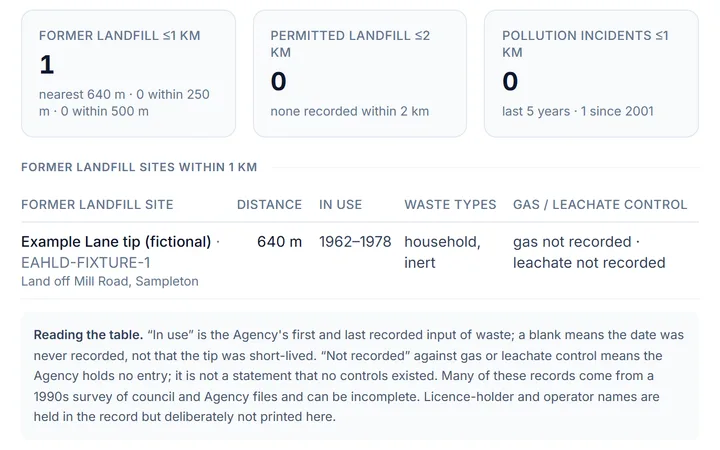 Landfill, permits and incidents nearby
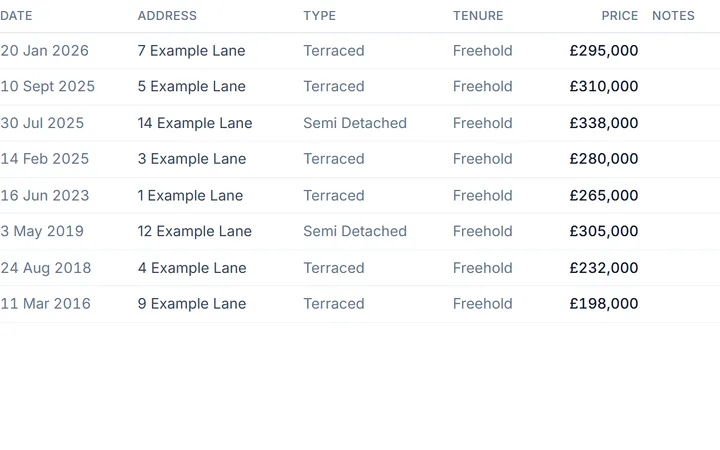 What homes here sold for
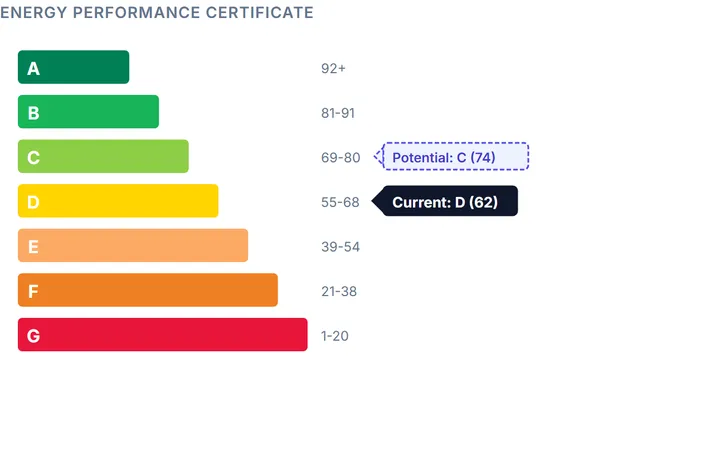 The energy rating, now and after upgrades
Illustrative sample · fictional address · cut from the sample report as it prints
Quick answer
The LPE1 is the Law Society's standard leasehold enquiries form, answered by the landlord or managing agent and usually requested by the seller's conveyancer after an offer is accepted. It covers what only the building's managers know: service charges, the reserve fund, buildings insurance, major works, ground rent and any lease extension or right-to-manage activity. A property report covers the other side: the flood, ground and mining risks under the building and the area around it. Read the pack for the money; use the report to know what to ask.
| Dimension | Pre-offer property report | LPE1 management pack |
|---|---|---|
| Who provides it | You order it yourself | The landlord or managing agent, usually at the seller's conveyancer's request |
| When | Before you offer | After an offer is accepted, during conveyancing |
| Service charges and accounts | Not covered | Yes |
| Reserve (sinking) fund | Not covered | Yes |
| Buildings insurance | Not covered, but it shows the ground and flood risks the policy should answer | Who arranges it and collects premiums; ask for the schedule too |
| Major works and Section 20 consultations | Not covered | Yes |
| Ground rent | Not covered | Yes |
| Lease extension, enfranchisement, right to manage | Not covered | Yes: whether any steps have been taken |
| Flood, ground and mining under the building | Yes, area screening from national datasets | No |
| Tenure at the last sale | Complete shows the tenure recorded at the last sale | Assumes leasehold; the lease sets the terms |
| Cost | £9.99 Lite / £24.99 Complete | A fee charged by the landlord or managing agent |
Our verdict
For a flat, the LPE1 pack is non-negotiable: it is where the true running cost of the home lives, and no public dataset can stand in for it. A pre-offer report is not a substitute, but it is the reason some questions are worth asking at all. A building on shrink–swell clay, in a flood zone or over former coal workings makes the insurance and repair answers in the pack far more important.
Check the building's ground before you offer
£9.99 Lite: flood, ground stability, radon and coal mining for the address. Emailed within 24 hours, usually faster.
Type the full address with its postcode to go straight to your report options. Try .
£24.99 one-off · no subscription · Human-checked and emailed to you. See a sample report · Review report options and coverage
Cancel for a full refund at any time before your report is emailed. Terms
What the LPE1 is and how you get it
When you buy a leasehold flat, much of what matters is not in the public record and not visible on a viewing. It sits with whoever runs the building: the landlord, a management company or a managing agent. The Law Society's LPE1 leasehold property enquiries form is the standard way of extracting it. The seller's conveyancer usually requests it once an offer is accepted, the managers complete it and charge for the pack, and your conveyancer reviews the answers.
What it asks
The form identifies who does what (who collects the service charge, who arranges and collects the buildings insurance, who maintains the building) and then asks about the money. Service charges and their accounts. Ground rent. The reserve fund, which the form defines as “a fund which allows the build-up of monies to pay for repair and replacement of major items or to equalise cyclical expenditure.” Major works and consultations under section 20 of the Landlord and Tenant Act 1985, the process landlords must follow before certain large works. And whether any steps have been taken towards enfranchisement, a lease extension or the right to manage.
Read it for direction of travel as much as for the current figures. A service charge that has climbed every year, a reserve fund that is close to empty and a Section 20 notice for a new roof together describe a bill that will land on whoever owns the flat next.
What it does not tell you
The LPE1 does not set out the lease, as its length and its clauses come from the lease itself, which your conveyancer reads. And it says nothing about the ground the building stands on, its flood exposure or the area around it. For a flat, those risks reach you indirectly: ground movement affects the building's structure, which the landlord normally maintains and insures, and which the leaseholders pay for through the service charge. A ground or flood flag on a flat is therefore not a reason to commission your own foundations survey. It is a set of questions for the managing agent.
- Has there ever been a subsidence or flood claim on the building, and what was done?
- What does the buildings insurance schedule cover, and is there a raised excess for subsidence or flood?
- Which trees stand close to the building, and who owns them?
- When were the roof and structure last inspected, and is the reserve fund sized for what was found?
Alterations: a flat is not a house in planning law
The national permitted development order defines a dwellinghouse so that it “does not include a building containing one or more flats, or a flat contained within such a building.” Householder permitted development rights therefore do not apply to flats. Work that needs planning permission needs it in the ordinary way, and many leases separately require the landlord's consent. If the flat has been altered, ask for both.
Where a property report fits
You see the LPE1 after your offer has been accepted, when you have already started paying for legal work. A pre-offer property report runs before that. It screens the address for flood risk, ground stability, radon and coal mining from national datasets, so you know which of the questions above matter for this building before you commit. £24.99 Complete adds the tenure recorded at the last sale, planning designations and the wider area picture. Our leasehold flat guide covers the rest of the checklist.
Buying a flat? Screen the building first
£24.99 Complete adds tenure at the last sale, planning designations and area data. One-off, emailed within 24 hours, usually faster.
Type the full address with its postcode to go straight to your report options. Try .
£24.99 one-off · no subscription · Human-checked and emailed to you. See a sample report · Review report options and coverage
Sources
- Leasehold forms (LPE1), The Law Society
- Landlord and Tenant Act 1985, section 20 (consultation on major works), legislation.gov.uk
- Town and Country Planning (General Permitted Development) (England) Order 2015, article 2, legislation.gov.uk
How HouseCheckup works
From search to full report in three simple steps.
- England, Wales & Scotland
Search any address
Enter an address in England, Wales and Scotland. Coverage varies by nation and source.
- Before you pay
See the IQ Score
See an initial area risk screen where enough data is available, with the checks and coverage behind the score.
- Emailed within 24 hours
Get the full report
Choose Lite (£9.99) or Complete (£24.99). The report is emailed to you within 24 hours, usually faster, with every source named and any check it could not run stated.
Frequently asked questions
What is an LPE1 form?
Who fills in the LPE1?
What should I look for in an LPE1 pack?
Does the LPE1 tell me how long the lease is?
Can a property report replace the LPE1?
Can I alter a leasehold flat without planning permission?
Still have a question? We typically respond within 24 hours.
Ready to check a property?
Enter the address you are thinking of buying. See the available area risk data, then choose an emailed report for the property.
Type the full address with its postcode to go straight to your report options. Try .
Reports from £9.99, one-off. Compare Lite and Complete
Cancel for a full refund at any time before your report is emailed. Terms
At a glance
One-off
No subscription
Pay once for each report you buy.
Named
Sources & coverage
Every report names its sources and the checks it could not run.
GB
England, Wales & Scotland
Coverage varies by nation and source, and is stated.
£9.99
Reports from
Lite £9.99, Complete £24.99.