Comparison guide
Missing building regs: indemnity insurance or regularisation?
Last updated:
Type the full address with its postcode to go straight to your report options. Try .
- 65+ official sources
- Emailed within 24 hours, usually faster
- Sources and coverage gaps named
- One-off payment, no subscription
What the report looks like inside
See the full sample →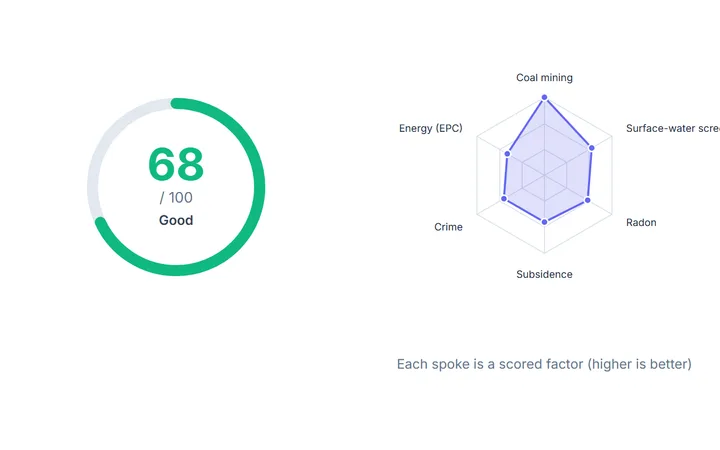 IQ Score and the factors behind it
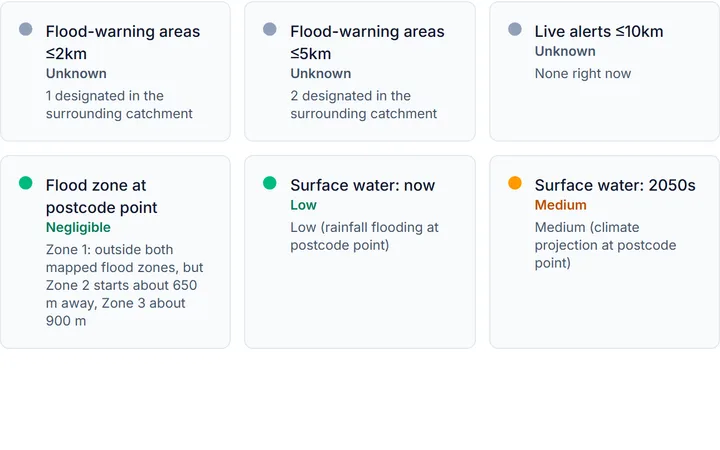 Flood risk at the postcode point
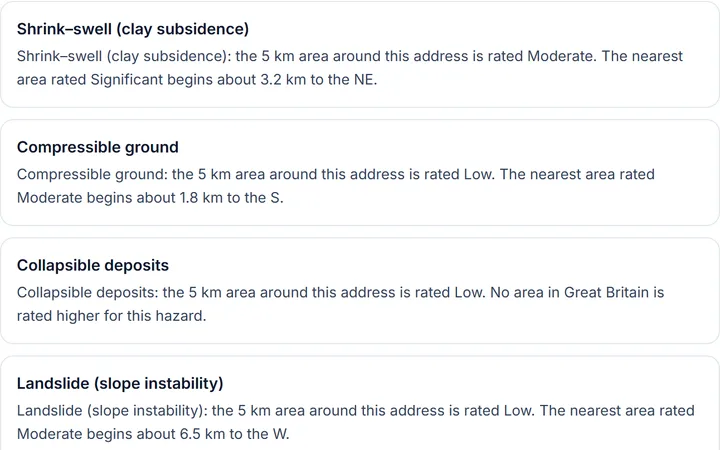 Six ground hazards, rated for the area
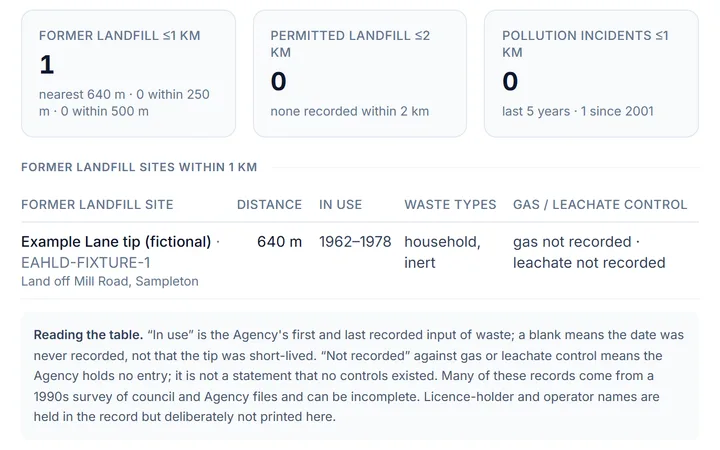 Landfill, permits and incidents nearby
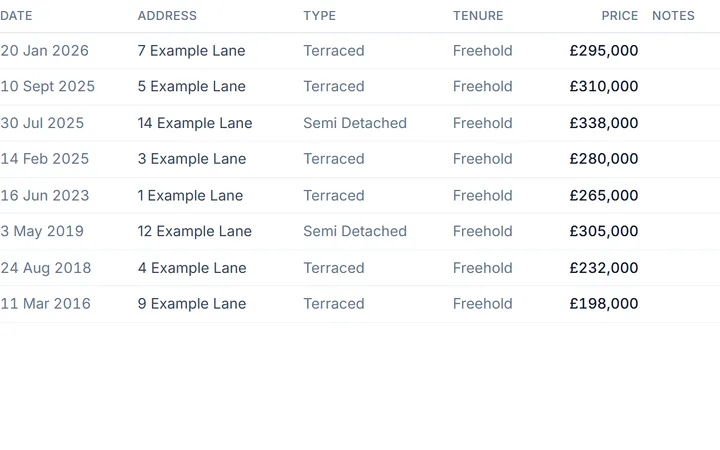 What homes here sold for
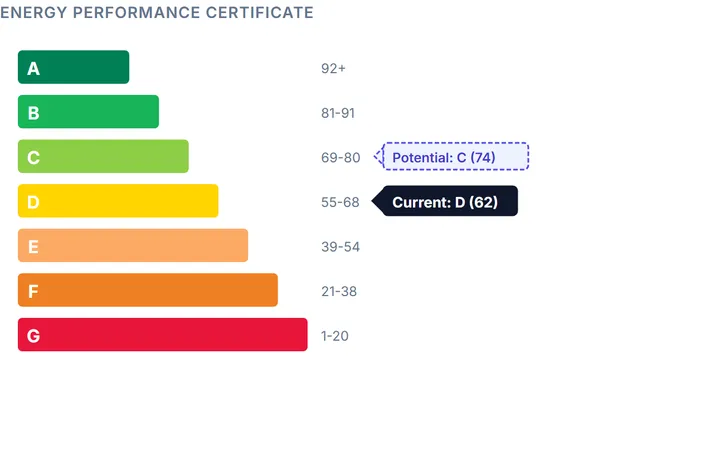 The energy rating, now and after upgrades
Illustrative sample · fictional address · cut from the sample report as it prints
Quick answer
They solve different problems. An indemnity policy (HomeOwners Alliance gives about £175 for a straightforward policy on a £500,000 sale) pays certain losses if the council later takes enforcement action; it says nothing about whether the work is safe, and it is usually void if anyone contacts the council. A regularisation certificate is retrospective approval for unauthorised work done on or after 11 November 1985: it can show the work complies, but the council may make you open it up first. If you care whether the extension is sound, only an inspection answers that.
| Dimension | Indemnity insurance | Regularisation certificate |
|---|---|---|
| What it is | An insurance policy against certain losses from enforcement action | Retrospective approval from the council's building control |
| Says the work is safe? | No, nobody inspects anything | It is evidence, though not conclusive evidence, that the named requirements were met |
| Who arranges it | Usually a conveyancer | The owner applies to the local authority |
| Main catch | Usually void if anyone approaches the council about the work | The council may require opening up, tests or samples, and further work |
| Which work | Whatever the insurer agrees to cover | Unauthorised work done on or after 11 November 1985 (England) |
| Cost | About £175 on a £500,000 sale for a straightforward policy (HomeOwners Alliance) | The council's fee, plus any opening up and remedial work |
| Speed | Days | Depends on the council and on what has to be opened up |
Our verdict
For minor, long-standing work that a surveyor is happy with, an indemnity policy your lender accepts is a pragmatic way to keep a purchase moving. For structural or fire-safety work (a loft conversion, a removed load-bearing wall, a large extension), insurance answers the wrong question. Ask the seller to regularise before exchange, or price the risk in, and get the altered parts inspected whichever route you take.
Spot the extension before you offer
£24.99 Complete includes planning designations and hand-checked registers for the address. Emailed within 24 hours, usually faster.
Type the full address with its postcode to go straight to your report options. Try .
£24.99 one-off · no subscription · Human-checked and emailed to you. See a sample report · Review report options and coverage
Cancel for a full refund at any time before your report is emailed. Terms
Two consents, two certificates
Building work on a house can need two separate things. Planning permission decides whether you may build something at all, and what it looks like and is used for. Building regulations approval governs how it is built: structure, fire safety, insulation, ventilation, drainage. GOV.UK warns that without building regulations approval “you will not have the certificates of compliance you may need when you want to sell your home”, which is exactly where buyers meet the problem.
The two are easy to confuse. Many single-storey extensions are permitted development and never need a planning application, yet still need building regulations approval. A seller who says “we did not need permission” may be right about planning and still have no completion certificate. For work done under a competent person scheme (replacement windows, a new boiler, rewiring), the installer's scheme certificate is the evidence instead, so ask for those too.
The enforcement clocks are longer than they were
A missing certificate matters because the council can act on non-compliant work. Under section 36 of the Building Act 1984, a notice requiring offending work to be removed or altered could once be served only within 12 months of completion. In England, since 1 October 2023, the limit is 10 years from completion; Wales followed on 1 July 2026. Transitional rules govern older work, so the limit that applies to a particular extension is a question for your conveyancer.
Planning enforcement changed too. For operational development substantially completed in England on or after 25 April 2024, a single 10-year limit applies; the old four-year rule still governs development completed before that date. The practical upshot for a buyer is simple: recent unapproved work carries a real enforcement risk for longer than the old rules of thumb suggest.
What an indemnity policy does, and does not do
A building regulations indemnity policy covers certain financial losses if the council takes enforcement action over the missing approval. It is cheap, quick and arranged by the conveyancer, which is why it is so common. But it is insurance against a council acting, not a statement about the building: nobody inspects the work, and a policy will not pay to put right a defect simply because it is a defect.
The condition that catches people out is the one about the council. Policies usually become void if anyone approaches the council about the work. That means you cannot ask building control whether they have records, and you cannot start a regularisation application, without losing the cover. Decide on the route first.
What regularisation involves
Regularisation is the formal route to retrospective approval. In England the application covers unauthorised work carried out on or after 11 November 1985 and includes a description of the work and plans of it and of anything needed to bring it up to standard. The council may require the work to be laid open for inspection, tested or sampled, and may require changes. If it is satisfied, it issues a regularisation certificate: evidence, though not conclusive evidence, that the requirements it names have been met.
That is more disruptive and slower than insurance, and the outcome is not guaranteed. It is also the only one of the two routes that tells you anything about the work. As a buyer the cleanest version is the seller regularising before exchange, at the seller's cost and risk.
Spotting the issue before you offer
Most buyers discover a missing certificate weeks into the conveyancing, after paying for a survey and searches. You can often see the warning signs earlier. Energy performance certificates record extensions, and comparing certificates over time against the last sale date can show whether work was done under the current owner, who should then hold the paperwork. The hand-checked section of a £24.99 Complete report covers registers that have no API; for an altered house that can include the council's planning and building-control records, where the council lets them be searched, and the report says so when it does not. Then ask the questions in writing before you offer, and see our guide to reports and surveys for what the surveyor should look at.
Screen the property first
From £9.99. One-off, no subscription. Emailed within 24 hours, usually faster.
Type the full address with its postcode to go straight to your report options. Try .
£24.99 one-off · no subscription · Human-checked and emailed to you. See a sample report · Review report options and coverage
Sources
- Building Act 1984, section 36 (removal or alteration of offending work), legislation.gov.uk
- Building Regulations 2010, regulation 18 (unauthorised building work), legislation.gov.uk
- Building regulations approval, GOV.UK
- Enforcement appeals: key changes under the Levelling-up and Regeneration Act, GOV.UK
- No building regulations certificate? What can you do?, HomeOwners Alliance
How HouseCheckup works
From search to full report in three simple steps.
- England, Wales & Scotland
Search any address
Enter an address in England, Wales and Scotland. Coverage varies by nation and source.
- Before you pay
See the IQ Score
See an initial area risk screen where enough data is available, with the checks and coverage behind the score.
- Emailed within 24 hours
Get the full report
Choose Lite (£9.99) or Complete (£24.99). The report is emailed to you within 24 hours, usually faster, with every source named and any check it could not run stated.
Frequently asked questions
Can I buy a house without a building regulations completion certificate?
What does building regulations indemnity insurance cover?
How much does indemnity insurance for lack of building regs cost?
What is a regularisation certificate?
Can the council still take action on work done years ago?
Is planning permission the same as building regulations approval?
Why should I not contact the council if I am relying on an indemnity policy?
Still have a question? We typically respond within 24 hours.
Ready to check a property?
Enter the address you are thinking of buying. See the available area risk data, then choose an emailed report for the property.
Type the full address with its postcode to go straight to your report options. Try .
Reports from £9.99, one-off. Compare Lite and Complete
Cancel for a full refund at any time before your report is emailed. Terms
At a glance
One-off
No subscription
Pay once for each report you buy.
Named
Sources & coverage
Every report names its sources and the checks it could not run.
GB
England, Wales & Scotland
Coverage varies by nation and source, and is stated.
£9.99
Reports from
Lite £9.99, Complete £24.99.