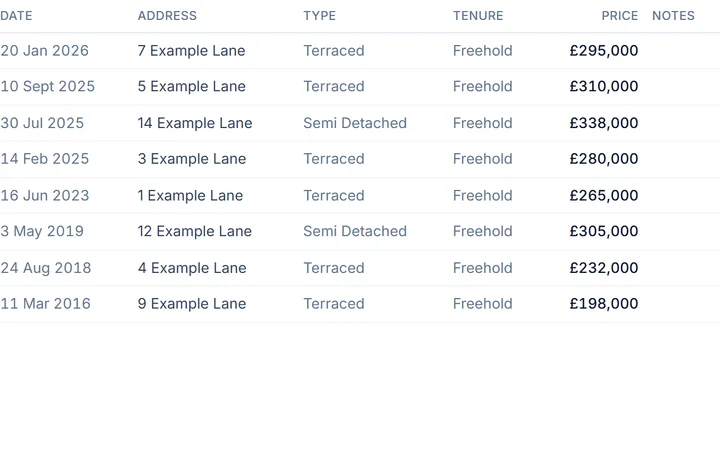
Approximately 420,000 planning applications are submitted in England annually, according to DLUHC statistics, with around 87% receiving approval. At HouseCheckup, our £24.99 property reports include planning history data for any address, showing previous applications and their outcomes, helping buyers understand what's been done to a property and what might be possible in the future. Whether you're planning an extension, a loft conversion, or a change of use, understanding the planning system is essential.
When Do You Need Planning Permission?
The general rule is that any "development" requires planning permission unless it falls within "permitted development rights." Development includes building works, material changes of use, engineering operations, and some changes to the appearance of a building.
You Typically Need Planning Permission For:
- Extensions that exceed permitted development limits (size, height, or proximity to boundaries)
- New buildings in your garden (above certain size limits)
- Change of use: converting a house to flats, a shop to a home, etc.
- Building a new dwelling: including subdividing a plot
- Work on listed buildings (Listed Building Consent is separate from planning permission)
- Significant alterations to the external appearance of a building in a conservation area
- Major tree works in conservation areas or on trees with Tree Preservation Orders
- Satellite dishes on the front elevation or in conservation areas
You Typically Don't Need Planning Permission For:
- Internal alterations (unless the building is listed)
- Repair and maintenance using similar materials
- Small extensions within permitted development limits
- Loft conversions within permitted development limits (up to 40m³ for terraces, 50m³ for detached/semis)
- Outbuildings within permitted development limits
- Solar panels (with some restrictions in conservation areas)
- Fences and walls under 1m adjacent to highways or 2m elsewhere
Permitted Development Rights Explained
Permitted development (PD) rights are automatic permissions granted by Parliament that allow certain types of work without a planning application. They are defined in the Town and Country Planning (General Permitted Development) (England) Order 2015 (as amended). Key PD rights for homeowners include:
Rear Extensions
- Single-storey: Up to 4m from the original rear wall (detached houses) or 3m (all others). Under prior approval, single-storey rear extensions can extend up to 8m (detached) or 6m (others)
- Two-storey: Up to 3m from the original rear wall, no closer than 7m to the rear boundary
- Height limits: Single-storey must not exceed 4m to the ridge. Two-storey must not exceed the height of the existing roof
Side Extensions
- Must be single-storey only under PD
- Maximum height of 4m
- Width must not exceed half the width of the original house
Loft Conversions
- Up to 40m³ additional roof space for terraced houses, 50m³ for detached and semi-detached
- Must not extend beyond the existing roof slope facing the highway
- Must not exceed the height of the existing roof ridge
- Materials must be similar in appearance to the existing house
Important: PD rights can be removed or restricted by the local authority through an Article 4 Direction, or by conditions on the original planning permission for the property. Always verify your PD rights with the local planning authority before starting work.
How to Apply for Planning Permission
- Pre-application advice: Most councils offer a pre-application service (£50–£600) where a planning officer reviews your proposal informally and identifies potential issues. This is strongly recommended for significant projects
- Prepare your application: You'll need completed application forms, site location plan (1:1250), block plan (1:500), existing and proposed floor plans and elevations, a design and access statement (for major applications), and the application fee
- Submit online: Most applications are submitted through the Planning Portal (planningportal.co.uk). Paper submissions are still possible but slower
- Validation: The council checks your application is complete. If anything is missing, they'll request additional information
- Consultation: Neighbours and statutory consultees (highways, environment agency, etc.) are notified and given 21 days to comment
- Decision: The planning officer assesses the application against the Local Plan, National Planning Policy Framework, and any material planning considerations. Most applications are decided within 8 weeks (minor applications) or 13 weeks (major applications)
Planning Application Fees
| Application Type | Fee (2026) |
|---|---|
| Householder application (extension, alteration) | £258 |
| Lawful Development Certificate (existing) | £129 |
| Lawful Development Certificate (proposed) | £129 |
| New dwelling(s) | £578 per dwelling |
| Change of use | £578 |
| Listed Building Consent | Free |
| Prior approval (larger home extension) | £120 |
What If Your Application Is Refused?
If your planning application is refused, you have several options:
- Negotiate: Contact the planning officer to discuss what changes would make the application acceptable, then resubmit (free within 12 months for householder applications)
- Appeal: Appeal to the Planning Inspectorate within 12 weeks of the refusal. Appeals are free but can take 6–12 months to determine
- Resubmit: Amend your proposal to address the reasons for refusal and submit a new application
Check Planning History Before You Buy
A HouseCheckup report for just £24.99 includes the planning history of any property, showing previous applications, their outcomes, and any conditions attached to approvals. This helps you understand what modifications have been made, whether they were approved, and what development potential the property may have. At £24.99, it's an essential tool for anyone buying a property with renovation or extension plans in mind.
Buying in this area? Check the exact property.
Complete (£24.99) brings available property records into a human-checked report. Flood and ground screening, crime, energy and sale-record context have different source and location limits. Postcode and regional data cannot establish the condition of a building; unanswered checks remain explicit.
Type the full address with its postcode to go straight to your report options. Try .
£24.99 one-off · no subscription · Human-checked and emailed to you. See a sample report · Review report options and coverage
Cancel for a full refund at any time before your report is emailed. Terms
Last updated: